Tuesday, 9 June 2026

The Johnston Baronetcy

SIR WILLIAM JOHNSTON, Knight, of Gilford, County Down, High Sheriff of County Down, 1717, County Armagh, 1721, married Nichola, daughter of SIR NICHOLAS ACHESON Bt (ancestor of the Earls of Gosford), by whom he had four sons and a daughter.
In 1700, he inherited the Gilford estates of his uncle, Sir John Magill Bt, the estate having been founded by Captain John Magill in the 1660s, when he was given leases for the creation of a small village beside an important ford in the River Bann.
Sir William died in 1722, and was succeeded by his eldest son,

RICHARD JOHNSTON (1710-58), High Sheriff of County Armagh, 1733, County Down, 1735, County Monaghan, 1738, who wedded, in 1737, Catherine, daughter of the Rev John Gill, and had issue,
Robert;
RICHARD, of whom we treat;
Nicolina; Catherine.
The younger son,

RICHARD JOHNSTON (1743-95), of Gilford, High Sheriff of County Down, 1765, County Armagh, 1771, MP for Kilbeggan, 1776, Blessington, 1783-95, espoused, in 1764, Anne, daughter of William Alexander, and had issue,
WILLIAM, of whom presently;
Mary Anne, m J Henry Burges, of Woodpark, Co Armagh;
Catherine, m Joseph Mason Ormsby.
Mr Johnston was created a baronet in 1772, designated of Gilford, County Down.

Johnston coat-of-arms

He was succeeded by his son,

SIR WILLIAM JOHNSTON, 2nd Baronet (1765-1841), High Sheriff of County Down, 1788, who died unmarried.

Sir William died at 32 Bryanston Square, London, and was buried at St Marylebone Church, London.

On his death, the baronetcy became extinct.
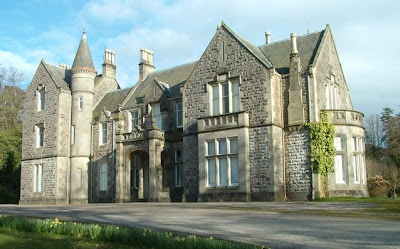
GILFORD CASTLE, Gilford, County Down, is a two-storey, Scottish-Baronial country house of ca 1870.

The entrance front has tall bay windows with balustrades; while the north front has a projecting gable wing with a side turret.

A slimmer projecting gable with window projection is on the ground floor.

An open stone porch with ball finials with balcony is over the doorway.

The brick outbuildings on the east front form part of a courtyard behind which there is a stone-faced, three-storey tower and stone arch into a courtyard.


The main house has five bedrooms, two bathrooms and four reception rooms, a large hallway and two kitchens.

The north wing has a further five bedrooms, two bathrooms and two reception rooms; while a smaller wing has two bedrooms, one bathroom and two reception rooms.

The house was built for Benjamin Dickson, a partner in the local linen thread company of Dunbar McMaster.

It replaced a much earlier castle built by a descendant of Gilford’s earliest proprietor.

However, the current house was seldom inhabited until the ancestors of the present owners acquired the property in the early 20th century.

"Gilford Castle" is first shown, captioned, on a map of 1901-2, situated at the heart of extensive, partially wooded grounds, captioned Gilford Castle Demesne.

Earlier maps show a much smaller building, "Gilford Castle", at the edge of the demesne where it adjoined the town at Castle Street.

The first castle at Gilford is thought to have been built by Captain William Johnston, of the Royal Irish Dragoons, who inherited part of the Gilford estates from the grandson of Captain John Magill, a soldier in Cromwell’s army who was the early proprietor of Gilford and from whom the name of the town derives.

The first castle was probably built in the early 1700s by Sir William.

After his death in 1722 the castle and estates passed to his son Richard, and his grandson, also Richard, but following the death of Richard Johnston’s son William in 1841, the baronetcy became extinct.

The original castle and demesne were sold by William’s younger sister Catherine to Benjamin Dickson, who built the present house.

The old castle fell into decay and was demolished in the 1860s prior to the completion of the new building.

The old castle stood on the south side of the present Castle Street, close to the road and on the edge of the demesne.

The present Gilford Castle, in the Scottish-Baronial style, was begun in the mid-1860s and completed ca 1870.

The designer is said to have been William Spence, a Scottish architect from Glasgow who also designed a house, Elmfield, for Dickson’s brother James.

Benjamin and James Dickson were partners in the Dunbar McMaster linen thread company on which the growth and prosperity of Gilford town was largely founded.

The new castle was considerably more centrally placed within the demesne and surrounding countryside and afforded a grand drive entrance.

Benjamin Dickson, however, does not appear to have ever inhabited Gilford Castle.

The castle was vacant until 1887, when it became the home of Percy Jocelyn McMaster, the younger brother of Hugh Dunbar McMaster, proprietor of Gilford Mill, who was resident at nearby Dunbarton House.

The house was let from Benjamin Dickson.

Nevertheless, McMaster’s tenancy was brief and by 1891 the house was again vacant.

A tenant named Purcell inhabited the castle for some time around 1896.

The 1901 census records the only occupant as being the gardener/caretaker, James Emerson, who occupied three rooms with his wife and six children, his 14-year-old daughter working as a seamstress.


In 1904 the house and demesne was purchased by Katherine Carleton for £15,000 (about £1.6 million today), the valuer noting that the cost of the building to Benjamin Dickson had been about £42,000 (circa £4.5 million today) and that the price paid by Carleton was ‘the value of the land alone, the castle being given for nothing’.

In Katherine Carleton, the castle found a long-term resident for the first time since it had been built.

The 1911 census indicated that the 54-year-old spinster inhabited the castle with a female companion and two domestic servants, a cook and a parlourmaid.

In 1914, the house was purchased by James F Wright, whose descendants continue to live in the castle today.

In 1934 the accommodation comprised two reception rooms, a billiards room, library, study, two kitchens, two pantries, a scullery, larder and dairy.

On the first floor were six bedrooms, two dressing rooms, two bathrooms, a nursery, a sewing room and three maids’ rooms.

The second floor comprised two attic rooms.

During the 2nd World War most of Northern Ireland was a training ground for allied troops and there was a large concentration of army personnel based in Gilford, which with its woods, lakes and rivers and proximity to major transport routes was ideally suited to military training purposes.

The army made use of Nissen Huts erected for the purpose in Gilford Castle demesne, and in 1943 the demesne housed a squadron of US troops together with their medical detachment who built a temporary hospital to the rear of the castle.

Documents show that 35 acres of land were requisitioned by the War Department in October, 1940, and a further 1 rood and 15 perches in July, 1941.

The castle is currently a family home, and the owner, Christine Wright, is a well-known local artist.

Gilford Castle has been home to the Wright family since it was bought in 1914 by James F Wright, the grandfather of Christine's late husband, Michael.

The property was purchased in 2019 by Adrienne and Robert Moffett, who have restored it and transformed the house into a prestigious hotel.

First published in January, 2011. The coat-of-arms is that of JOHNSTON OF KILMORE.

Monday, 8 June 2026

Menlough Castle

THE BLAKE BARONETS OWNED 2,030 ACRES OF LAND IN COUNTY GALWAY

The founder of this family in Ireland, Richard Blake, alias Caddell, is said to have accompanied Prince (afterwards King) JOHN into that kingdom, 1185, and obtained for his military services large grants of land in the counties of Galway, Mayo, Clare, and in the town of Galway.

THOMAS BLAKE, Mayor of Galway in 1545 and in 1562, was the third son of Valentine Blake, who died in 1499.

He died in 1574, seised of the castle and lands of Ballimacroe, now Carnmore, near Galway, which had been granted to Richard Caddle, called Niger, his ancestor.

His eldest son,

WALTER BLAKE, dvp 1573, leaving by his wife, Juliana, daughter of James Browne (FitzStephen), three sons,
VALENTINE;
James;
Robert, Mayor of Galway, 1624.
The eldest son,

VALENTINE BLAKE (1560-1635), married firstly, Margaret, daughter of Robert French, and had, with other issue,
THOMAS, his heir;
Margaret.
He wedded secondly, Annabel, daughter of James Lynch, without further issue.

Mr Blake, Mayor of Galway, MP for Galway, was created a baronet in 1622, designated of Menlough, County Galway.

Sir Valentine was succeeded by his eldest son,

SIR THOMAS BLAKE, 2nd Baronet, MP for Galway Borough, 1645-5, Mayor of Galway, 1637, who espoused Julianne, daughter of Geoffrey Browne, and was father of

SIR VALENTINE BLAKE, 3rd Baronet, of Menlough Castle, MP for County Galway, 1634-5, Galway Borough, 1639-42, Mayor of Galway, 1643, who wedded Eleanor, daughter of Sir Henry Lynch Bt, and had issue,
THOMAS, his successor;
Francis;
John;
Henry;
Julianne; Elizabeth; Annabel.
Sir Valentine died in 1652, and was succeeded by his eldest son,

SIR THOMAS BLAKE, 4th Baronet, who married firstly, in 1649, Mary, daughter of Richard Martin; and secondly, in 1656, Maria, daughter of Robert French, by whom he had issue,
VALENTINE, 5th Baronet;
WALTER, 6th Baronet.
Sir Thomas died ca 1670, and was succeeded by his elder son,

SIR VALENTINE BLAKE, 5th Baronet (1664-86), who fell in a duel, and leaving no issue, the title devolved upon his only brother,

SIR WALTER BLAKE, 6th Baronet, who was the first Catholic gentleman of distinction who joined the standard of the Prince of Orange, and obtained a commission from His Royal Highness to raise a regiment, which he maintained and clothed at his own expense.

Sir Walter, MP for Galway, 1689, wedded firstly, in 1687, Anne, daughter of Sir John Kirwan, and had, with other issue,
THOMAS, his successor;
Mary.
He espoused secondly, in 1706, Agnes, daughter of John Blake, and had further issue, a daughter, Catherine.

Sir Walter died in 1748, and was succeeded by his eldest son,

SIR THOMAS BLAKE, 7th Baronet, of Somerville, County Galway, who married, in 1716, Elizabeth, daughter of Ulick Burke, and had issue,
ULICK, his successor;
Anne.
Sir Thomas died in 1749, and was succeeded by his son,

SIR ULICK BLAKE, 8th Baronet, who wedded Mary, daughter of Richard Blake, though the marriage was without issue.

Sir Ulick died in 1766, when the title passed to his cousin,

SIR THOMAS BLAKE, 9th Baronet, who espoused, in 1730, Eleanor Lynch, though the marriage was without issue, and the title passed to his brother,

SIR WALTER BLAKE, 10th Baronet, who wedded, in 1751, Barbara, daughter of Myles Burke, and had issue,
JOHN, his successor;
Dominick Joseph;
Stephen;
Thomas;
Walter (Brigadier).
Sir Walter died in 1802, and was succeeded by his eldest son,

SIR JOHN BLAKE, 11th Baronet (1753-1834), who married firstly, in 1779, Eleanor, daughter of Edward Lynch, and had issue,
VALENTINE, his successor;
Barbara.
He espoused secondly, in 1800, Rose, daughter of Edward Brice, of Kilroot, County Antrim, by his wife Theodora, daughter of Thomas , 1st Baron Ventry, and had further issue,
John Brice;
Eliza; Jane Margaret; Arabella.
Sir John was succeeded by his eldest son,

SIR VALENTINE BLAKE, 12th Baronet (1780-1847), MP for Galway, 1813-20 and 1841-7, who wedded firstly, in 1803, Eliza, daughter of Joseph Donellan, and had issue,
THOMAS EDWARD, his successor;
John Francis;
Elly; Eleanor; Eliza.
He married secondly, in 1843, Julia Sophia, daughter of Robert MacDonnell, and had further issue, a son,
Valentine Charles.
Sir Valentine was succeeded by his eldest son,

SIR THOMAS EDWARD BLAKE, 13th Baronet (1805-75), who espoused, in 1830, Lætitia Maria, daughter of Ulick O'Brien, and had issue,
VALENTINE, his successor;
Louisa; Eliza Maria.
Sir Thomas was succeeded by his son,

SIR VALENTINE BLAKE, 14th Baronet (1836-1912), JP, High Sheriff of County Galway, 1872, Honorary Major, Galway Militia, who wedded, in 1864, Camilla Eugenia, daughter of Harvey Combe, and had issue,
THOMAS PATRICK ULICK JOHN HARVEY, his successor;
Valentine Joseph;
James Herbert;
Florence Anne; Maude Julia.
Sir Thomas was succeeded by his eldest son,

SIR THOMAS PATRICK ULICK JOHN HARVEY BLAKE, 15th Baronet (1870-1925), JP, Captain, Royal Garrison Artillery, who espoused, in 1903, Evelyn winifred, daughter of Lewes Arthur Stewart, and had issue, an only child,

SIR ULICK TEMPLE BLAKE, 16th Baronet (1904-63), Lieutenant, Royal Artillery, who married, in 1940, Betty, daughter of Arthur Gordon, and had issue, an only child,
THOMAS RICHARD VALENTINE, his successor.
Sir Ulick was found dead in his car after inheriting Menlough Castle.

He was succeeded by his son,

SIR THOMAS RICHARD VALENTINE BLAKE, 17th Baronet (1942-2008).
Sir Anthony Teilo Bruce Blake, 18th Baronet (1951–2014), great-great-great-great grandson of the 10th Baronet through his 2nd son, Dominck Joseph Blake (1754–1843);
Sir Charles Valentine Bruce Blake, 19th baronet (b 1994).

MENLOUGH CASTLE, County Galway, was originally a gabled 17th century tower-house on the bank of the river Corrib, two miles from Galway City.


The building had several additions and extensions during the 19th century, in including battlements, curvilinear gables, Georgian sashes etc.


In July, 1910, the castle was gutted by a catastrophic fire, in which a daughter of the 14th Baronet perished.

Menlough Castle was thereafter abandoned and has remained a ruin since then.

Other residence ~ Saltergill, Yarm, Yorkshire.

First published in September, 2018.

Seskinore House

THE McCLINTOCKS OWNED 4,553 ACRES OF LAND IN COUNTY TYRONE


JAMES PERRY, of Welsh descent, had a free farm grant of the lands of Mullaghmore, County Tyrone, from SIR AUDLEY MERVYN in 1662.

He had three sons, viz.
Francis, of Tattyreagh; m Francis, daughter of J Lowry, of Ahenis; dsp;
Samuel, m 1st Catherine, daughter of J Lowry, of Pomeroy;
GEORGE, of whom presently.
The third son,

GEORGE PERRY, of Mullaghmore, married Angel, daughter of the Rev James Sinclair, of HOLYHILL, near Strabane, County Tyrone, and had issue,
SAMUEL, of whom presently;
George;
Margaret; Letitia.
The eldest son,

SAMUEL PERRY, of Perrymount and Mullaghmore, wedded the daughter of _______ Olphert, of Ballyconnell House, County Donegal, and had issue,
GEORGE, of whom hereafter;
Mary, m
A McClintock; mother of SAMUEL, heir to his uncle.
The only son,

GEORGE PERRY (1762-), of Perrymount and Mullaghmore, a cornet of horse, espoused Mary, daughter of John Burgess, and niece of Sir John Smith Burgess Bt.

He dsp, and was succeeded by his nephew, the second son of his only sister, Mary,

SAMUEL McCLINTOCK JP (1790-1852), of Newtown, County Louth, and Seskinore, County Tyrone, High Sheriff of County Louth, 1843, who married firstly, Jane (d 1837), daughter of Lieutenant-Colonel Lane; and secondly, in 1839, Dorothea, fourth daughter of John Knox, by whom he had issue,
GEORGE PERRY, his heir;
Samuel John, d 1856.
The elder son,

GEORGE PERRY McCLINTOCK JP DL (1839-87), of Seskinore, Lieutenant-Colonel and Honorary Colonel, 4th Battalion, Royal Inniskilling Fusiliers, High Sheriff of County Tyrone, 1865, ADC to the Duke of Abercorn and the Earl Spencer when Lords Lieutenant of Ireland, married, in 1860, Amelia Henrietta, daughter of the Rev Samuel Alexander, Rector of Termon, and had issue,
BERESFORD GEORGE PERRY, 1861-70;
JOHN KNOX, of whom we treat;
Harry Edward, 1865-6;
Augustus, DSO;
Leopold Arthur;
Hubert Victor;
Guy Reginald;
Dorothea Selina Navarra; Amelia Charlotte Olivia; Eleanor Harriette Woodrop;
Madeline Frances Edith; Florence Beatrice Hanna.
His eldest surviving son,


COLONEL JOHN KNOX McCLINTOCK CBE JP DL (1864-1936), of Seskinore, High Sheriff of County Tyrone, 1891, ADC to the Governor of Northern Ireland, married, in 1893, Amy Henrietta, eldest daughter of John Stuart Eccles DL, of ECCLESVILLE, County Tyrone, and had an only daughter,

AMELIA (Leila) ISOBEL McCLINTOCK (1898-1937), of Seskinore, who married twice.

By her second husband, Wilfred (Tony) Heyman Joynson-Wreford (1896-1940) she had an only daughter,

XENIA PENELOPE JOYNSON-WREFORD, born in 1935.

*****

A TRAGIC series of events befell the McClintocks and Seskinore in 1937: Leila McClintock died suddenly, aged 38, of Meningitis.

Her beloved husband Tony, already broken-hearted at his wife's death, died himself, three years later, aged 44, of Tuberculosis.

They are both buried beside each other at the family burial ground in Seskinore.

Xenia was left an orphan.

Amy (Amelia Henrietta) McClintock died in 1942 and was buried at St Lawrence Church in Effingham, Surrey.
Her gravestone, shared with her sister Anna, stills bears a very clear inscription and their burials are recorded solidly in the church’s Burial Register.
At this stage, the Seskinore estate comprised 129 acres.

*****

THE FOLLOWING ARTICLE IS TAKEN FROM THE BELFAST NEWSLETTER NEWSPAPER OF 2008

THE lost heiress of an Ulster village has been found after 70 years – on the other side of the world.

Xenia Lewis, who has lived in Australia most of her life, has been crowned the rightful owner of the McClintock estate in Seskinore, just outside Omagh.

The 73-year-old, who was born in the tiny hamlet, only realised she was entitled to the inheritance when she joined a social networking site on the web.

Mrs Lewis, formerly Xenia Penelope Joynson-Wreford, made the connection to her true roots when she discovered an email on Friends Reunited – from a half-brother she never knew existed.

Pat Joynson-Wreford – a son from their father Pat’s first marriage – had posted the message in a bid to track down ancestors of the family.

While Pat never dreamed a living relative would be found, he found himself reunited with his long-lost sister.

Initially, Xenia thought someone was playing a joke on her when she first found the email earlier this year – but eventually replied and the pieces of her disjointed family history fell into place.

Xenia’s mother, Lila, died from meningitis when she was only 15 months old; and her father died from TB when she was four.

She was put in the custody of guardians who were friends of her parents – but they told her nothing of her family.

She was moved around the world, from France to India, before she settled "Down Under".

Her family estate, which once had 4,553 acres, a mansion house and mill, was sold to fund her privileged upbringing.

Xenia never knew trustees handling her parents’ money supported her through boarding and finishing school.

Even though her schooling turned her into a lady, she was kept in the dark over the title she had at home and her connections to the McClintock family.

Xenia, who paid a whirlwind visit to Northern Ireland a fortnight ago to pick up her father’s will, now knows she is the granddaughter of Colonel John Knox McClintock CBE.

Money from her estate is long-gone – only pictures tell of its statures – and there is no title to go with her birthright.

But Xenia is annoyed she cannot remember anything of her early life at Seskinore,
“I don’t know if I have just blocked it out because I was taken away from my family. I would dearly love to remember something of my father but I just can’t do it. I have not even got any memories of this house. I would dearly love to remember something.”
On discovering her parents graves in a garden on the estate, Xenia said,
“They are happy and where they would want to be – together. I just wish I did not live so far away where I can’t look after them. But I will be back again next year to come and see them. Like Pat said to me, they are probably sitting up there saying to each other at least you have now found us.”
SESKINORE HOUSE, near Fintona, County Tyrone, comprised two storeys and a mid-19th century aspect.

The entrance front had two bays on either side of a pedimented breakfront, with three narrow, round-headed windows above; and a balustraded Ionic portico below, the outside columns coupled. 

There was a curved end bow.


The house was remodelled and extended in 1862 to a design by Sir Charles Lanyon, and included five reception rooms and ten bedrooms plus staff quarters. 

Seskinore Forest Walk goes through Seskinore Forest and passes the courtyard and stable block, all that now remains of the McClintock Estate.

The forest is predominantly mixed or deciduous and therefore changes with the seasons.

It is thought that the estate was sold  to the Northern Ireland forest service in 1941, following Tony Joynson-Wreford's death.

Seskinore House was demolished by the forest service in 1952.


The small chapel of ease of 1873 remains, though. 

It was erected on the McClintock estate to designs of Robert A Ferguson, of Londonderry, and located to the north side of Seskinore Road.

The main body of the church is simply detailed and enlivened by the ornate plate tracery windows with carved label-stops.

The church has strong historical association with the McClintock Family who owned the estate prior to the erection of the church.

The family's private burial ground remains to the east of the church, a good example of a small rural chapel of fine workmanship in original condition. 

The McClintock of Seskinore website contains information and images of Seskinore House, the McClintocks and associated families.

I am grateful to Alex Watson.

First published in October, 2010.

Sunday, 7 June 2026

Round the Coast of Northern Ireland

The Rev Canon Hugh Forde, sometime Rector of Tamlaghtfinlagan (Ballykelly), and a canon of St Columb's Cathedral, Derry, was author of SKETCHES OF OLDEN DAYS IN NORTHERN IRELAND and the book I am going to quote from, Round the Coast of Northern Ireland.

Canon Forde wrote the latter book in 1928, and the foreward was written by the RIGHT HON SIR JOHN ROSS, 1st Baronet, last Lord Chancellor of Ireland.


LORD ROSEBERY, speaking of the Scottish settlers in Ulster, at the Edinburgh Philosophical Institute in 1911, said of them:-
"We know that the term Ulster-Scot is generic, and simply means Scoto-Irish. 
I love the Highlanders and I love the Lowlanders, but when I come to the branch of our race that has been grated on the Ulster stem, I take off my hat with veneration and awe. 
They are, I believe, the toughest, the most dominant, the most irresistible race that exists in the universe at this moment."
The passage is quoted by Sir John Ross in his book Pilgrim Scrip.

"It is true that the people are dominant and irresistible.

On the terrible day of Thiepval, 1st July, 1916, they exhibited a gallantry and sacrifice that have never been surpassed.

In the early part of the 18th century the Anglican bishops most unwisely proceeded to enforce the Act of Uniformity, the result of which was that about 100,000 Ulstermen of the Scottish breed migrated to the country that afterwards became the United States of America.

Here they were planted on the Indian frontier, where massacres of the settlers were matters of frequent occurrence.

In spite of the tomahawk, and the scalping knife, the dour race held its ground till it had driven back the savage foes.

The dour race did not forget  how they had been treated  by England and the English Bishops.

When the War of Independence came on they formed the backbone of Washington's army.

FURTHER, there was a time when peace could easily have been effected between the mother country and the revolting States, but the Ulster men would hear of no compromise and insisted on independence.

"As separation was inevitable some time," Sir John goes on to say, "perhaps their persistence did real service to England itself. They have left their mark upon the United States to this day in the peculiar intonation of their accent and in the Puritanical character of their ideals."

First published in April, 2019.

Saturday, 6 June 2026

Albion Place, Belfast

Albion Place ca 1900 (Image: A R Hogg/NMNI)

Numbers 16-42 Bradbury Place, Belfast, formerly Albion Place, a terrace of three-storey, early Victorian houses, were built between 1832-48.

The first houses to be constructed had triangular pediments above the first-floor windows; with moulded surrounds at second-floor level.

One of which boasted a balustraded parapet and fluted urns.

The front gardens were all built over with single-storey shops about 1900.

The balustraded building to the left has been absorbed into Lavery's bar.

A section of the terrace was demolished in 1866 to make way for the railway line, leaving the site vacant. 

The original developer of the site, Martin Wallace, was living in Albion Place in 1880.

Marcus Patton, OBE, in his Central Belfast: A Historical Gazetteer, remarks that
"the southern end and the mid-terrace house at nos. 24-26 were demolished in 1990, which has effectively terminated the life of the terrace as a whole." 
"It is a great shame that the terrace was not developed from the rear, as separate access existed to the two-storey mews houses behind from Albion Lane."
30-44 Bradbury Place, 2022 (Timothy Ferres)

Incidentally, I visited Albion Lane in June, 2022, and it was in a sad state, with large council wheeled bins proliferating along the alley, and various obstructions along the entire length of the Lane.

Numbers 30-44 in the terrace were all demolished in 2021, in preparation for a block of student accommodation.

First published in June, 2022.

Friday, 5 June 2026

Ingoldsby of Carton

The Family of INGOLDSBY was of ancient standing in Lincolnshire, and derived in direct descent from Sir Roger Ingoldsby, Lord of Ingoldsby, in that county, in 1230.


SIR RICHARD INGOLDSBY, Knight, of Lethenborough, Buckinghamshire, High Sheriff of Buckinghamshire, 1606, was found, by an inquisition taken at the demise of his father, Francis Ingoldsby, in 1634, to be his eldest son and heir.

He married Elizabeth, daughter of William Palmer, of Waddesdon, Buckinghamshire, and had issue,
RICHARD, his heir;
Dorothy; Agnes; Martha.
Sir Richard died in 1635, and was succeeded by his son,

SIR RICHARD INGOLDSBY, of Lethenborough, knighted by JAMES I in 1617, when that monarch visited Hinchingbrooke, the seat of Sir Richard's father-in-law, Sir Oliver Cromwell KB.

He wedded Elizabeth, daughter of Sir Oliver, and had issue,
Francis;
Richard;
Oliver;
John;
Henry, created a baronet, 1661, of Lethenborough;
GEORGE, of whom we treat;
Thomas;
William;
Elizabeth; Sarah; Ann; Mary.
The sixth son,

SIR GEORGE INGOLDSBY (1624-1701), of Lenborough Manor, Buckinghamshire, a colonel in Cromwell's army in Ireland, Mayor of Limerick, 1672, married Mary, daughter of James Gould, of Ludden Castle, Corbally, County Limerick, and had a son,

THE RT HON RICHARD INGOLDSBY (c1664-1712), MP for Limerick City, 1703-12, Lieutenant-General in the army, a Lord Justice of Ireland, 1709-10.

General Ingoldsby purchased CARTON HOUSE and demesne for the sum of £1,800 (equivalemt to about £304,000 in 2021) in 1703 from the TALBOTS.

He wedded Frances, daughter of Colonel James Naper, of LOUGHCREW, County Meath, and had issue, 

HENRY INGOLDSBY (c1692-1731), MP for Limerick City, 1713-31, who married Catherine, daughter of Sir Constantine Phipps.

Ingoldsby crest

Henry Ingoldsby squandered most of his father's accumulated fortune on a lavish lifestyle in London, and following his death, his estates were sold to pay off his debts; and, in 1738, Carton returned to its ancestral owners, the FitzGeralds of Kildare, premier dukes, marquesses, and earls of Ireland.

First published in June, 2022.

Rathgael Album: II

Rathgael House ca 1939

John Lowry, a descendant of the Rose-Clelands, of Rathgael House, near Bangor, County Down, has kindly sent me more photographs of Rathgael and its lake.


At Rathgael Lake ca 1940

John's father, Desmond H D Lowry (wearing glasses) is second from the left on the rowing-boat.

Rathgael Lake (Timothy Ferres, 2022)

I visited Rathgael in 1922, and it's now being redeveloped as a very fine housing.

Rathgael Lake (Timothy Ferres, 2022)

The lake is still there, and will be part of this new development.


The castellated twin towers guarded the entrance to the walled yard.


A cannon was strategically sited in the grounds.


First published in May, 2020.